
Allow, deny or review every transaction in real time
Send any event your platform handles to one API endpoint: a card authorization, a login, a payout, a wallet transfer or anything else you define. Moon Signals Intelligence checks it against your rules and live risk signals and returns a decision within an 80 ms budget. Built-in private AI writes, explains and improves your rules, and gives your compliance team the context to decide every case.
How a decision is made
- 1. The event arrivesYour platform sends the event to the evaluate endpoint. Its payload is checked against the fields and data types you set.
- 2. Your signals come with itYour platform adds device, location, VPN and sanctions signals from your risk partners to the event. Moon never calls the partners or holds their credentials.
- 3. Variables updateCounters, sums and sets track behavior, such as authorizations per card per hour or the last merchant country.
- 4. Rules decideYour published rules return allowed, denied or pending review, with the rules that matched.
- 5. Actions are requestedA denial can ask your system to freeze the card or step up verification. Your system carries it out.
- 6. Cases are reviewedFlagged events open a case with a priority. A compliance officer approves or denies, and a webhook tells your system.
Safe rule changes
Change rules without putting live decisions at risk
Every rule moves through four stages before it can change a decision, and every published version is kept.
- 1
Draft
Edit freely. A draft never runs on live events.
- 2
Simulate
Dry-run it against sample events. Nothing is written, no case opens and no webhook fires.
- 3
Shadow
Run it on live traffic and record what it would have done, without changing a single decision.
- 4
Publish
It becomes the live version and starts deciding.
Roll back to any earlier version if a change misbehaves.
Everything your risk team works with, in one place
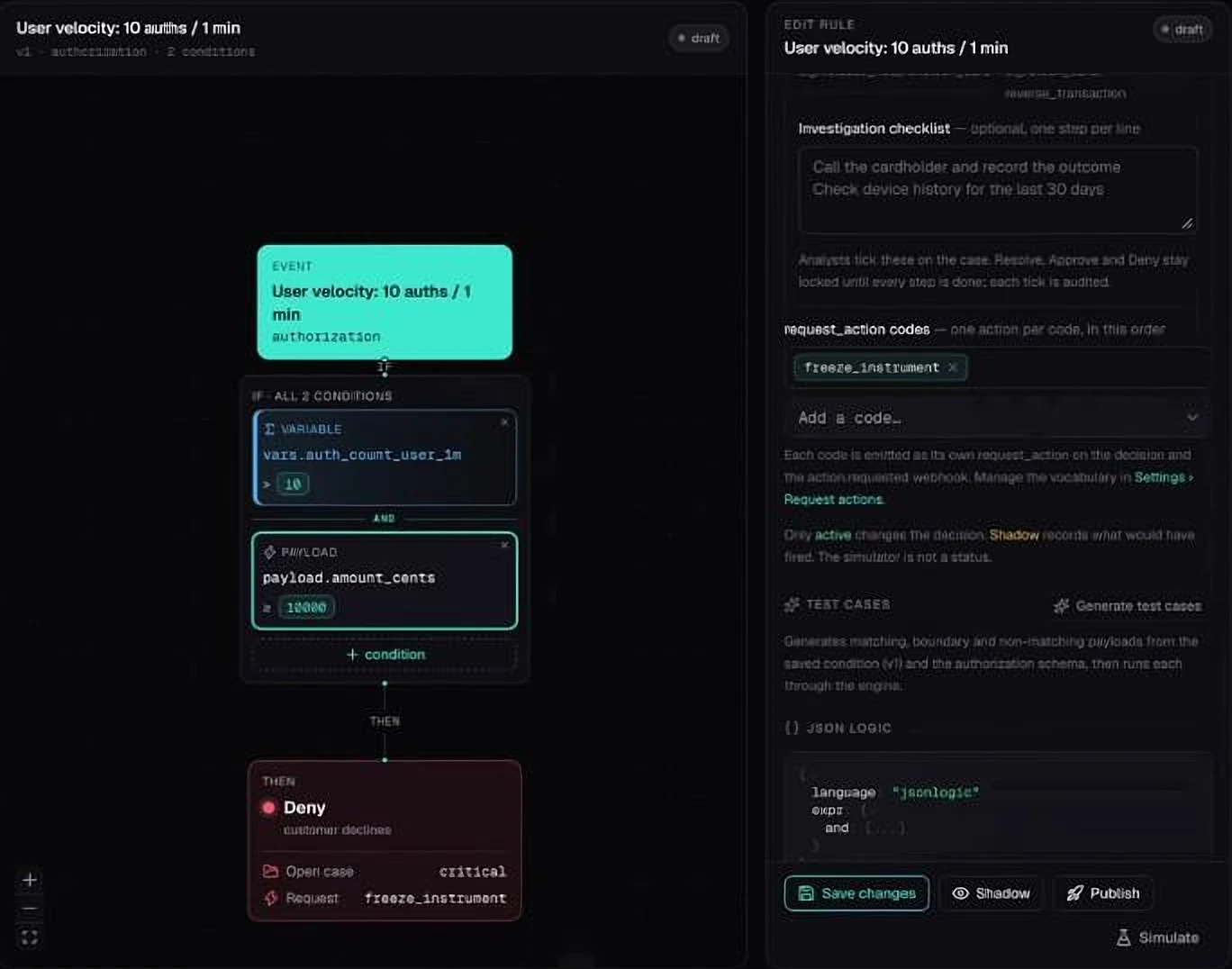
Build rules on one canvas
Start from a template such as user velocity, or describe the rule to the AI. The event, conditions, decision and requested action sit on one canvas, and every version is saved with a change log.
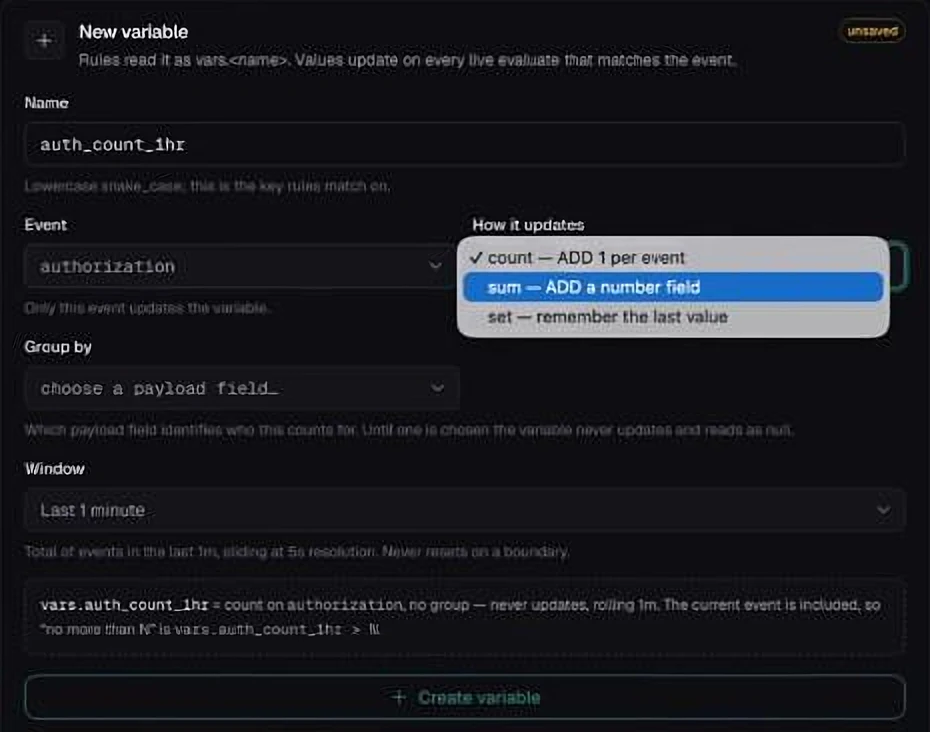
Track by any field
Counters, sums and sets can be grouped by any field in the event: card, user, wallet, merchant, device or the whole tenant. Count a card's authorizations in the last minute, add up a user's spend this week, or remember the last country a wallet paid from.
Test any version before it goes live
Run a sample event through the simulator and change one field to see the decision change. With a VPN on in the Netherlands, the authorization goes to review; turn the VPN off and it's allowed. It's a dry run: nothing is written, no case opens and no webhook fires.
Decision
Decision
Review cases as a team
Flagged events open a case with a priority, and every case shows why it fired: the rule and the conditions that matched. Operators work the queue and escalate to a compliance officer, who approves or denies.
Why it fired · Velocity v4
- 3 authorizations in the last hour (limit 2)
- Merchant country is new for this card
Also built in
Events you define
Set up each event type, such as authorizations, logins or payout requests, with its own payload. Required fields and data types are checked on every call, and an incomplete event is rejected.
A full audit trail
Every setting, rule edit and case decision is logged with who made it, when, and exactly what changed.

Powered by Innerworks
Best-in-class device fingerprinting and geolocation
Add Innerworks signals to each event and use them in any rule: spot the same device behind many accounts, or a login from somewhere the user has never been. You send the signals with the event; Moon never calls Innerworks or holds your Innerworks keys.
Partner signals
Sanctions and wallet risk in every rule
Send your blockchain analytics provider's results with the event and use them in any rule: OFAC sanctions matches, direct and indirect exposure, alert levels and KYT status. As with every partner, you send the data with the event; Moon never calls the provider or holds your keys.
Example rule
More signals from partners
Rules can look past the transaction itself. You send partner data with each event, so you can weigh what is already known about who is behind it. Moon never calls your partners or stores their credentials.
Deconflict: verified intelligence (coming soon)
Intelligence contributed by participating law-enforcement agencies shows whether a wallet or transaction is already linked to crime or fraud: data that analytics alone can't see.
Your own risk data
Sanctions flags, risk scores and any other field your providers send can be added to an event and used in rules.
AI
Have AI analyze your transactions
Built-in private AI works alongside your analysts: it turns ideas into rules, explains them, finds patterns in your own history and gives compliance officers the context to decide every case.
Every rule explained
Open any rule and get a plain-language explanation of what it checks and when it fires.
Suggestions from your own data
The AI reviews your transaction history and audit log and suggests new rules or tighter limits where your rules miss a pattern.
Context for every case
Before a compliance officer decides, the AI goes through the history of past cases, so every decision is better supported.
Pick your model
Your choice of AI. Your data stays private.
Choose where the AI runs. Your transaction data is never used to train a model, isn't kept after the answer, and never reaches the model makers' own servers.
Rule writing, explanations and summaries run with zero data retention: nothing is kept once the answer is back. Case reviews go further and run inside a hardware-sealed confidential computing enclave, where even the people running the servers can't see the data.
- Zero data retention for rule work and summaries
- Cases analyzed in a sealed confidential computing enclave
- Enclave runs end-to-end encrypted, with cryptographic proof
Leading models from the top AI companies, run by AWS on AWS infrastructure. Prompts and answers won't be stored or logged, and they're never shared with the model's maker.
- Zero data retention
- Models run on AWS, not the model makers' servers
- Never shared with model providers or used for training
 Prem AI
 Amazon Bedrock
Models from:

 OpenAI
 xAI
 Google
- Model fallback If a model is unavailable, the request falls back to a backup model, so the AI features keep working.
- Nothing readable is logged Each AI call is logged with the model used, a hash of the input and the token count, never the prompt text.
Infrastructure
Built to sit in front of every decision
Decides before the payment is approved
Every evaluation runs within an 80 ms budget, fast enough for card authorizations, logins, payouts and transfers.
80 ms budget
No extra hops
Rules run inside the API itself, so a decision never waits on a separate rules service.
In-API rule engine · counters in DynamoDB
Nothing slow in the way
Webhooks and cases go out after the decision, so they never hold it up.
Queued off the decision path
You choose how it fails
If an evaluation errors or times out, each event type either allows or denies, as you set it.
Fail open / fail closed per event
Same answer on a retry
Retry a call and you get the same decision back, never a second action.
Idempotency keys
Trust every webhook
Your system can check that every webhook really came from Moon.
Signed webhooks
Stays up under load
Production scales with your traffic and keeps running if a data center goes down.
AWS · Multi-AZ database · autoscaling
Run it your way
Use it with your Moon card program or host it yourself, with separate keys, users and roles for each business you run.
Multi-tenant · self-hosting
Developers
One endpoint, one decision
Send an event and get the decision back in the same call. Build against a staging environment first, then switch to production.
One evaluate endpoint
Every event type goes to the same endpoint, authenticated with your API key.
A staging environment
Test your integration and your rules on staging before anything touches production.
An Integration page per tenant
Each tenant has its own Integration page in the dashboard, with its keys and connection details.
x-api-key: YOUR_API_KEY

{
  "event_type": "authorization",
  "payload": {
    "card_id": "card_abc",
    "user_id": "user_123",
    "amount_cents": 24000,
    "currency": "USD",
    "mcc": "5411",
    "channel": "pos",
    "signals": {
      "innerworks": {
        "country_code": "NL",
        "vpn_is_enabled": true
      }
    }
  }
}{
"evaluation_id": "eval_7c2e41",
"event_type": "authorization",
"decision": "review",
"matched_rules": ["rule_vpn_new_country"],
"actions": [],
"vars": {
"auth_count_1hr": 1,
"auth_last_country": "NL"
},
"dry_run": false
}Example, shortened. The same VPN-in-the-Netherlands event as in the simulator.
Questions about Moon Signals Intelligence
- Do we need a Moon card program to use it?
- No. It works with any platform that can make an API call. Moon card clients can add it to their programs, and other businesses can license it on its own, including to host on their own infrastructure.
- What can it check besides card payments?
- Any event your platform defines: card authorizations, logins, payout or transfer requests, account changes. If you can describe it in a payload, you can write rules for it.
- Does Moon freeze cards or block users for us?
- No. Moon Signals Intelligence returns a decision and any actions you've asked for, such as freezing the card. Your system carries out the action, so you stay in control of your customers' accounts.
- How does the AI help our team?
- It writes rules from plain-language descriptions, explains existing rules, suggests improvements from your transaction history and audit log, and reviews past cases for compliance officers. Nothing changes until someone on your team publishes it. It runs on Prem AI with zero data retention, and case reviews run in a sealed confidential computing enclave. Leading models on Amazon Bedrock are coming soon.
- What happens if an evaluation fails or times out?
- You decide for each event type. Fail open allows the event; fail closed denies it.
- Who reviews flagged transactions?
- Your team. Operators work the case queue and can escalate to users with the compliance officer role, who approve or deny. Every decision is logged and sent to your system by webhook.
- Can we start with a pilot?
- Yes. Start with one event type, such as card authorizations, test your rules in the simulator and publish them when you're ready.
Put a decision engine in front of every payment
Tell us which events you want to watch, and we'll help you set up your first rules and a pilot.